
This guide is for software developers, engineering managers, and DevOps teams seeking to improve code quality and development efficiency. We cover the top code quality tools, their features, and how they enhance development workflows.
Code quality tools are essential for ensuring high-quality code and improving development efficiency in software development. As a type of static code analysis tool, code quality tools help developers write cleaner, more reliable, and more secure code by automating code analysis and review. These tools analyze code for issues related to maintainability, security, and performance. They automatically review, identify issues, and suggest improvements.
These tools help development teams detect bugs, security vulnerabilities, and code smells early in the development process. By catching issues early, code quality tools improve code quality and help maintain reliable and secure codebases. Automating code reviews helps catch common errors instantly, freeing up human reviewers.
Code quality tools support various stages of the software development life cycle, including code analysis, code review, and continuous integration. A static code analysis tool is a key category, used for continuous inspection of code quality to detect bugs, enforce standards, and monitor security risks. These tools can enhance security by automatically identifying common vulnerabilities like SQL injection or hardcoded secrets before the code reaches production.
Code formatters and code refactoring tools are also important types of code quality tools, helping to maintain consistent style and improve code structure.
Choosing the best code quality tools is crucial for optimizing projects and improving code quality. Using these tools improves code quality by catching bugs before deployment, which saves time, money, and reputation.
These tools automatically scan your codebase to identify potential bugs, performance issues, security risks, and deviations from best practices.
Code quality tools are essential in today's software development landscape, helping organizations reduce bugs, improve performance, and ensure security. Code quality tools automate checks for standards, performance, and vulnerabilities, leading to reliable software. They help developers write cleaner, more reliable, and more secure code.
Code quality refers to the degree to which software meets its requirements, is reliable, and is easy to maintain. High-quality code is about how easy it is to read, test, and maintain. High-quality code is essential for ensuring the security, performance, and reliability of software applications. Code quality tools help developers write cleaner, more reliable, and more secure code.
Code quality metrics, such as cyclomatic complexity and code coverage, help measure the quality of code, and understanding how to reduce cyclomatic complexity is key to improving maintainability.
Understanding code quality is critical for development teams to ensure they are writing secure, efficient, and maintainable code.
To effectively measure and improve code quality, development teams rely on specific metrics
Code quality measurement refers to the process of evaluating software code based on predefined standards and metrics. Code quality metrics provide insights into the quality of code, helping development teams identify areas for improvement.
The main measures of code quality include cyclomatic complexity, code coverage, technical debt, and code duplication:
These metrics help development teams measure the effectiveness of their code quality tools and processes, and focusing on essential software quality metrics that truly matter ensures they track what most impacts reliability and performance.
By tracking code quality metrics, teams can ensure they are meeting their code quality goals and improving their development efficiency.
Next, let's explore the key features that make a code quality tool effective.
A good code quality tool should provide automated code analysis, code review, and continuous integration capabilities.
The tool should also provide actionable insights and intelligent refactoring suggestions to help development teams improve their code quality.
By understanding these features, teams can select the right tool for their needs. The next section explains the process of code analysis in more detail.
Source code analysis is the process of scanning code to detect errors, security vulnerabilities, and code smells. Static analysis tools analyze code without executing it to find issues. A static analysis engine can detect coding errors, logic errors, runtime errors, null pointer dereferences, buffer overflows, and other associated security vulnerabilities. Static code analysis tools automatically examine source code for code quality issues, vulnerability detection, and coding standard violations.
Static code analysis tools, such as SonarQube and ESLint, provide deep static analysis and scanning of code. ESLint is a static code analysis tool for identifying problematic patterns in JavaScript code. Tools like SpotBugs analyze Java code to identify bugs and programming errors, while PVS-Studio is a static code analysis tool used for C, C++, C#, and Java. There are also tools specifically designed to analyze Python codebases, helping enforce standards and detect issues. Source code scanning tool accuracy depends on strong vulnerability detection and the ability to detect vulnerabilities such as cross-site scripting (XSS), cross-site scripting, and security flaws early.
Code analysis helps development teams identify areas for improvement and ensure their code meets secure coding standards.
By analyzing code regularly, teams can catch errors early and improve their overall code quality.
With code analysis in place, the next step is to ensure code quality through effective code review processes, supported by the best code review tools that streamline collaboration and enforcement of standards.
Selecting the right code review tool is crucial for maintaining high code quality, ensuring consistent coding standards, and catching code errors early in the development process, and teams should focus on optimizing code reviews to boost developer productivity when designing their workflows. The following section highlights the top code review tools for 2025.
Here are five leading code review tools that development teams are leveraging to enhance their workflows in 2025, with a detailed comparison to help you choose the best fit for your needs:
Typo
Typo stands out as a lightweight yet powerful code review tool that combines static application security testing (SAST) with an AI reasoning engine. It focuses on improving code readability and enforcing consistent coding standards. Typo supports multiple languages and integrates smoothly with popular version control systems, providing in-line comments and actionable insights. Its strength lies in detecting duplicated code and ensuring adherence to best practices, making it an excellent choice for teams emphasizing code quality and maintainability without overwhelming complexity. For teams comparing alternatives, Snyk Code offers AI-powered automated code scanning for vulnerabilities, while software composition analysis is often paired with these tools to manage third-party dependencies and license risk.
CodeRabbit
CodeRabbit offers automated code scanning and review capabilities designed for seamless integration with existing CI/CD pipelines. It provides real-time feedback on pull requests, detecting code smells, security vulnerabilities, and coding style issues. Its intelligent refactoring suggestions help improve code architecture and maintainability. Compared to Typo, CodeRabbit is more focused on delivering comprehensive scanning with an emphasis on maintainability and security, suitable for teams seeking deep integration and actionable insights within their development workflows.
CodeAnt
CodeAnt combines traditional static analysis tools with AI-powered automation to uncover security issues early and improve overall code health. It supports integration with automated testing frameworks and offers detailed test coverage analysis, making it a comprehensive solution for enterprise teams aiming to maintain high code quality across large and complex codebases. While Typo is lightweight and developer-friendly, CodeAnt is geared towards enterprises requiring robust security and testing integration. Fortify SCA supports 1,657 vulnerability categories across multiple languages for teams that need especially broad coverage.
Graphite
Graphite specializes in providing advanced analytics around pull requests and code review workflows. It helps teams measure essential code quality metrics such as technical debt, code duplication, and test coverage trends over time. Its seamless integration with GitHub and GitLab enables teams to optimize their review processes and improve development efficiency. Unlike Typo, which focuses on code readability and standards enforcement, Graphite is ideal for teams that want deep insights and metrics-driven improvement strategies.
Aikido Security
Aikido Security is a developer-first code quality and security platform that merges static application security testing with automated remediation. It detects code smells, security vulnerabilities, and code errors in real time, directly within pull requests. Its AI-driven analysis offers intelligent refactoring suggestions and helps teams uncover security issues early while maintaining consistent code quality. Aikido is suited for teams prioritizing security alongside code quality, offering a sophisticated solution that balances automation with actionable developer feedback.
These code review tools not only automate code analysis and security scanning but also promote better collaboration and faster development cycles by providing actionable insights and real-time feedback within the development workflow, and they pave the way for adopting the best AI code review tools as teams mature their practices.
After selecting the right code review tool, it's important to enforce coding standards across the team by following top best practices for code review that encourage consistent, constructive feedback.
With coding standards in place, integrating code quality tools into CI/CD pipelines is the next step for continuous improvement.
CI/CD pipelines are essential for ensuring continuous integration and delivery of software applications.
Code quality tools should integrate seamlessly with CI/CD pipelines to provide automated code analysis and testing. Tools like SonarQube enable continuous inspection of code quality within these pipelines. Teams can also use pre-commit hooks to enforce local checks before code enters CI/CD pipelines.
By integrating code quality tools with CI/CD pipelines, teams can ensure their code is tested and analyzed regularly, improving their overall code quality. SonarQube is a popular open-source platform for continuous inspection of code quality.
This integration also helps teams catch errors early and reduce the risk of security vulnerabilities.
Integrating code quality tools with CI/CD pipelines sets the stage for improving overall development efficiency and supports secure development practices within broader software development processes.
Improved efficiency leads to high-quality code, which brings significant benefits to organizations.
One way to maintain high-quality code is by detecting and removing dead code.
Selecting the right code quality tool is crucial for maximizing these benefits. The next section provides guidance on how to choose the best tool for your team.
Leveraging the optimal static analysis tool or static analyzer for your team’s needs transforms how development teams approach software excellence, fundamentally reshaping their capacity to ensure robust, secure, and maintainable codebases throughout the entire development lifecycle. With an unprecedented array of sophisticated options available, teams must dive into comprehensive evaluations that analyze each tool's capability to automate intricate code analysis workflows, compare how well it detects code quality issues and supports vulnerability detection, deliver comprehensive quality metrics that directly affect development outcomes, and integrate seamlessly within existing CI/CD infrastructures.
The strategic approach comprises prioritizing transformative features such as static code analysis engines, automated review mechanisms, real-time feedback systems, and support for static and dynamic analysis as complementary capabilities to evaluate in modern platforms—all of which fundamentally enhance teams' ability to identify critical issues early while maintaining consistent quality standards across development phases. Furthermore, the ideal solution should facilitate automated scanning capabilities, support dynamic analysis where runtime behavior needs to be assessed, and generate actionable insights that streamline workflows without introducing unnecessary complexity that could hinder development velocity. Software Composition Analysis (SCA) checks dependencies for known vulnerabilities and strengthens application security testing, complementing static code analysis that focuses on issues within your own codebase.
Tools such as SonarQube, ESLint, and CodeClimate exemplify these transformative qualities by delivering unprecedented code analysis depth, supporting diverse programming languages, and offering seamless integration pathways with popular CI/CD systems that enhance overall development efficiency. github advanced security is also a strong fit for organizations already working inside GitHub. By strategically leveraging a tool that aligns with their comprehensive development methodology, teams can systematically reduce technical debt accumulation, accelerate development efficiency metrics, and ensure their codebase architecture remains maintainable and secure across all deployment phases.
Once the right tool is selected, teams can focus on continuous improvement of code quality, using metrics such as lines of code counts in context alongside more robust quality indicators.
Following best practices is key to maintaining high code quality.
AI-powered tools are increasingly important for code quality and efficiency, especially for distributed teams dealing with remote code reviews powered by AI.
In today's rapidly evolving software development ecosystem, AI-powered code quality tools have become essential infrastructure components for engineering teams delivering production-grade applications at scale. By integrating these intelligent automation systems into CI/CD pipelines, organizations enable their development teams to leverage machine learning algorithms for sophisticated code analysis, automated pull request reviews, and vulnerability scanning with static analysis security testing (SAST). This AI-driven automation accelerates the detection of code defects and security vulnerabilities while ensuring code maintainability and technical debt management remain prioritized throughout the entire software development lifecycle.
AI-powered code quality platforms, including specialized AI code review tools, streamline development workflows by delivering real-time feedback through intelligent code analysis engines and actionable insights derived from historical codebase patterns, enabling teams to remediate issues before they compound into substantial technical debt. Automated code review systems utilizing natural language processing and machine learning models enforce consistent coding standards and best practices, facilitating seamless team collaboration and unified codebase maintenance. Consequently, development teams can allocate more resources toward feature innovation and architectural improvements rather than manual code inspection processes, resulting in accelerated release velocities and enhanced software reliability metrics.
Furthermore, these AI-driven tools play a critical role in identifying hidden security vulnerabilities through advanced threat modeling and static code analysis, significantly reducing attack surface exposure and ensuring adherence to secure coding frameworks like OWASP guidelines. By continuously monitoring code health metrics and promoting industry best practices through intelligent recommendation engines, AI-powered code quality tools enable teams to maintain high-performance codebases, minimize technical debt accumulation, and deliver robust, production-ready applications to market with greater velocity. Ultimately, embedding AI-driven code quality tools across every stage of the software development lifecycle represents a proven methodology for optimizing engineering efficiency, reducing security risks, and achieving sustainable software excellence at enterprise scale.
Efficient workflows are the result of these improvements.
The relationship between code quality and development is fundamental to software success.
Code quality comprises a fundamental cornerstone that directly influences every phase of the development lifecycle, reshaping how software reliability, security, and maintainability are achieved across modern development environments. Elevated code quality standards not only minimize technical debt accumulation but also streamline development workflows, enabling development teams to deliver robust, enterprise-grade applications with enhanced velocity and precision. Mature source code analysis programs often combine static and dynamic analysis to strengthen code security across the lifecycle. Code quality tools serve as intelligent gatekeepers by enforcing secure coding standards, detecting code smells and anti-patterns, while ensuring optimal test coverage metrics that drive consistent software excellence. These tools also help ensure the development of secure code by analyzing source code, including Java source code where relevant, to identify security vulnerabilities early in the process and surface concurrent code risks such as data races, supporting secure coding practices and compliance requirements. Integrating these sophisticated tools into CI/CD pipelines facilitates automated code analysis and enables early detection of security vulnerabilities, which proves especially valuable for enterprise teams managing large-scale, complex codebases with distributed architectures. Advanced tools such as Greptile, Pylint, and Flake8 provide intelligent refactoring suggestions, analyze code for potential errors and performance bottlenecks, and support multiple programming languages, making them versatile assets for optimizing code architecture and enhancing readability across diverse technology stacks. Furthermore, systematic code review processes and automated testing frameworks help development teams maintain elevated code quality standards, eliminate duplicated code implementations, and ensure that codebases adhere to established organizational guidelines and industry best practices. By embedding quality assessment tools into the software development process, organizations can achieve consistent, high-caliber code delivery while fostering a culture of continuous improvement and technical excellence that drives long-term software sustainability.
In conclusion, code quality tools fundamentally transform development teams' ability to deliver high-quality, secure, and maintainable software solutions. By strategically integrating the optimal tools into development workflows, teams unlock unprecedented improvements in code quality, dramatically reduce technical debt, and streamline development efficiency. Essential capabilities such as static code analysis, automated code review, and seamless CI/CD pipeline integration ensure that code analysis and testing become deeply embedded within the development ecosystem, driving consistent quality standards across all projects. Leveraging comprehensive code quality metrics—encompassing code coverage, test coverage, and code duplication analysis—delivers actionable insights into code health and empowers teams to make data-driven optimization decisions. As software development landscapes continue evolving, code quality tools will emerge as increasingly critical infrastructure components. By prioritizing code quality initiatives and harnessing advanced quality automation tools, development teams deliver software solutions that achieve the highest security, reliability, and maintainability benchmarks. Ultimately, strategic investment in code quality tools transforms teams' capabilities to produce code that transcends mere functionality—creating robust, efficient, and future-resilient solutions that drive exceptional customer satisfaction and sustainable business growth.

Working collaboratively on a project means multiple people have different ideas and opinions. While working on an open source code with multiple people, imagine what happens if everyone starts updating the code haphazardly whenever they want to; that would be chaotic for the result.
In a public repository, the community of developers collaborates by reviewing and suggesting improvements to code, ensuring that contributions are organized and maintain high quality.
This is where pull requests can help your team.
A pull request, also called a merge request, is a fundamental feature in version control systems like Git that enables developers to suggest changes to a codebase, repository, or software development project. Pull requests are typically made against the default branch of the main repository, which is often called 'main' or 'master', but some projects use a develop branch for ongoing development before merging to main. The pull request button serves as a distinct platform for discussing and reviewing code changes and discussing the new feature. It enables keeping updates separate from the main project, promoting internal collaboration and potentially external involvement, and streamlining the debugging process. Pull requests help protect the user experience by ensuring that only reviewed and approved changes reach users, minimizing the risk of user-facing issues. Additionally, the pull request review process allows errors to be detected and rectified before deployment, minimizing the risk of introducing destabilizing elements. If issues are identified after merging, it is possible to revert a Git pull request using several different methods to ensure stability.

Software development represents a sophisticated, multi-faceted orchestration that transcends conventional code authoring paradigms. From comprehensive requirement analysis and architectural blueprinting to rigorous quality assurance protocols and production deployment strategies, each developmental phase necessitates seamless coordination among distributed development teams and cross-functional stakeholders. Strategic collaboration frameworks prove instrumental in ensuring that iterative code modifications integrate harmoniously while optimizing deliverable outcomes that align with predefined project objectives and organizational requirements.
Among the most transformative mechanisms for facilitating sophisticated collaboration workflows in modern software development ecosystems is the pull request methodology. Pull requests enable development professionals to systematically propose code enhancements, solicit comprehensive peer reviews, and engage in technical discourse regarding optimization opportunities before merging contributions into the centralized codebase repository. This structured approach not only elevates code quality standards and enforces best practices but also streamlines the integration processes for implementing new functionality and addressing critical fixes. By leveraging pull request workflows, development teams can orchestrate code modifications with unprecedented efficiency, minimize deployment risks, and ensure comprehensive alignment across all stakeholders throughout the entire software development lifecycle.
When architecting comprehensive development workflows for novel functionality implementation or defect remediation initiatives, software engineering practitioners should leverage sophisticated branching strategies through dedicated feature branch creation. This methodology facilitates optimal isolation of developmental workstreams from primary codebase branches and concurrent development initiatives, thereby enhancing code management efficiency and streamlining collaborative review processes. To orchestrate branch instantiation, developers utilize the git checkout command enhanced with the -b parameter specification. For instance, executing git checkout -b feature/new-feature will dynamically generate a designated branch termed feature/new-feature while simultaneously transitioning the working environment to the newly established branch context.
Upon successful migration to the designated development branch, engineering professionals can implement requisite codebase modifications, commit transformations to local repository instances, and subsequently propagate the branch architecture to distributed repository infrastructures. This sophisticated workflow methodology ensures that each innovative functionality enhancement or remediation initiative undergoes independent development lifecycles, thereby facilitating comprehensive progress tracking capabilities and enabling thorough change assessment protocols prior to integration into the primary codebase ecosystem.
Maintaining synchronization between your local repository and the latest modifications from the remote repository comprises a fundamental cornerstone in collaborative software development workflows. The git pull command leverages sophisticated version control mechanisms to retrieve updates from remote repositories and seamlessly integrate them into your local branch architecture. For instance, executing git pull origin main facilitates the acquisition of the most current modifications from the main branch residing on the remote repository while simultaneously merging these changes into your local main branch infrastructure.
Following the completion and commitment of local modifications, developers utilize git push operations to synchronize the remote repository with their newly generated commits. This approach ensures that all team members maintain comprehensive access to the most current codebase iterations while preserving the main branch's contemporary status. Systematically implementing pull and push operations enhances conflict prevention mechanisms and optimizes the development process flow, thereby facilitating streamlined collaborative software engineering workflows.
Establishing a mature pull request process is crucial for any development team, particularly when managing a large or remote workforce. It serves as a backbone for enhancing productivity and efficiency within the team. The process involves requesting code reviews and approval from a project maintainer, ensuring that changes are properly evaluated before merging. Let’s explore how a structured pull request approach offers significant benefits: The notification aspect of pull requests is particularly useful because it alerts project maintainers when changes are ready for review.
A mature pull request process allows developers to suggest changes and share them with the rest of the team. It not only helps streamline the workflow but also fosters an environment of continuous learning through feedback and suggestions. This process ensures efficient code reviews and controlled integration of changes into the codebase, boosting overall productivity. Pull requests create a record of changes, discussions, and approvals that serve as a valuable audit trail.
Pull requests encourage valuable communication and feedback between reviewers and contributors. Reviewers can leave a comment directly on specific lines of code within a pull request, using comments as a feedback mechanism to address concerns, pose questions, and suggest improvements. This collaborative approach fosters peer review, knowledge sharing, and a shared understanding among team members, leading to superior solutions and effective conflict resolution.
A robust pull request process is vital for the engineering manager to track the entire software build process. It acts as a central hub where developers propose changes, providing the manager with the ability to review, offer feedback, and monitor progress. This visibility into code modifications and team discussions enhances alignment with project objectives and quality control. Integration with project management and continuous integration systems offers a comprehensive view, ensuring streamlined coordination and oversight.
Acting as a gatekeeper, a mature pull request process ensures code quality through structured and collaborative code reviews, automated testing, and adherence to coding standards. This process guarantees that proposed changes meet project standards, maintain code quality, and comply with best practices.
Draft pull requests allow for incremental development, enabling developers to work on code changes before final integration into the main codebase. During this process, follow up commits and additional commits can be made to address feedback, fix issues, or refine the code before final approval, supporting ongoing collaboration and iterative improvement. Developers can continue to make changes to the files in a pull request by adding new commits to their head branch after the pull request is opened.
This mechanism encourages continuous feedback and peer reviews, ensuring that the software development process remains flexible and aligned with project goals and standards.
In conclusion, establishing a mature pull request process is indispensable for enhancing a development team’s productivity and efficiency. It provides a solid framework for collaboration, quality assurance, and process tracking, ultimately leading to successful project outcomes.
When a software engineer seeks to implement comprehensive feature enhancements within a project ecosystem, the methodology typically comprises establishing a dedicated development branch specifically architected for that particular functionality enhancement. The developer leverages advanced version control systems to orchestrate necessary code transformations, systematically committing these modifications to the newly instantiated branch architecture, subsequently synchronizing the branch with the distributed repository infrastructure through strategic push operations. Once the feature implementation reaches optimal maturity, the developer initiates a sophisticated pull request mechanism designed to facilitate the strategic integration of the enhanced functionality into the primary development branch.
The pull request undergoes rigorous examination through comprehensive peer review processes conducted by fellow software engineers and project stewards, who systematically analyze the proposed modifications, provide strategic feedback recommendations, mandate additional optimization requirements, or authorize the integration request based on predetermined quality benchmarks. Upon successful validation and approval of the pull request, the enhanced code architecture becomes seamlessly integrated into the main development branch, thereby incorporating the newly developed functionality into the core software infrastructure. This streamlined workflow ensures that all code transformations undergo thorough validation and comprehensive testing protocols before integration into the project ecosystem, maintaining elevated standards for software quality assurance and collaborative development excellence.
Managing pull requests is one of the most challenging and time-consuming parts of the software development process. These challenges are amplified when there are many developers working on the same project simultaneously. A few of them include: Pull requests help keep teams motivated by highlighting and notifying the team when someone completes a new feature.
In large-scale projects, even when the team can communicate face-to-face or via email, there are always risks of something going wrong. Human errors, such as forgetting crucial details, are inevitable. Moreover, email threads can become an intricate web that complicates following discussions, leading to misunderstandings and missed information.
Note: To avoid miscommunication, it is important to document key decisions and action items clearly and share them with all relevant team members.
Implementing robust project management tools can help track all communication and changes effectively. Ensuring regular team check-ins and establishing clear communication protocols can mitigate these risks.
Managing branching for each pull request may become complicated when larger projects with multiple features or bug fixes are developed concurrently. Managing the source branch and ensuring that changes are merged from the same repository can help reduce complexity. It may also happen that change in one branch leads to change in another. Therefore, the interdependency can lead to a complex branching structure.
The engineering team must ensure that the branches are properly named, isolated, and updated with the latest changes from the main codebase.
Managing a large number of pull requests is time-consuming. Each new pull request requires careful review and tracking to avoid bottlenecks in the workflow. Especially, when the pull requests are many and very few developers to review them. This further increases the frequency of merges into the main branch which can disrupt the development workflow.
The engineering team must set a daily limit on how many PRs they can open in a day. Besides this, automated testing, continuous integration, and code formatting tools can also help streamline the process and make it easier for developers.
During peer review, merge conflicts are a common challenge among developers. It may happen that the two developers have made changes to the same line of code. This further results in conflict as the version controller isn’t sure which one to keep and which one to discard. Keeping your local repo updated with the latest changes from the remote repository can help prevent such conflicts.
One of the best ways to improve team communication and using project management tools to keep track of the changes. Define areas of the codebase clearly and assign code ownership to specific team members.
Conflicts also arise when multiple developers make changes to different portions of the codebase at the same time. These changes are often made on each developer's local machine before being pushed to the shared repository. This can lead to integration issues that disrupt the overall development workflow.
Establishing clear code ownership and utilizing version control systems efficiently ensures smoother integration. Regularly updating branches with the latest changes can prevent many of these conflicts.
By addressing these challenges with strategic solutions, teams can manage collaborative development projects more effectively, ensuring smoother workflows and successful project outcomes.
Setting and tracking improvement goals is essential for development teams striving to enhance productivity and efficiency. Here's a comprehensive guide on how teams can achieve this:
By following these steps, development teams can effectively set and track improvement goals, leading to more efficient operation and faster delivery of features.
When making a pull request, ensure you make it as easy as possible for the reviewer to approve or provide feedback. To do this well, here are the components of a good pull request:

Pull request creating involves several steps that may vary depending on the version control platform. A pull request involves proposing changes, reviewing, and merging, which can differ slightly between platforms like GitHub, GitLab, or Bitbucket. Creating a pull request often involves drafting a title and description for the changes being proposed.
Here are the steps to create a pull request: 1.
Step 1: The developer creates a branch or a fork of the main project repository. A forked repository allows developers to prepare changes independently before submitting a pull request. 1.
Step 2: The developer then makes the changes to this cloned code to create new features or fix an issue or make a codebase more efficient 1.
Step 3: This branch is pushed to the remote repository, and then a pull request is made 1.
Step 4: The reviewer is notified of the new changes and then provides feedback or approves the change. Pull requests can be linked to issues to show that a fix is in progress and can automatically close the issue when merged.
Step 5: Once the change is approved, it is merged into the project repository
Once a pull request is made, fellow developers can review the alterations and offer their thoughts. Their feedback can be given through comments on the pull request, proposing modifications, or giving the green light to the changes as they are. The purpose of the review stage is to guarantee that the changes are of top-notch quality, adhere to the project's criteria, and align with the project's objectives.
If there are any changes required to be made, the developer is alerted for updating process. If not, a merging process takes place where the changes are added to the codebase.
Understanding the elements that prolong the cycle time during the code review stage is crucial for improving efficiency. Here are the primary factors:
Addressing these areas effectively can lead to faster and more efficient code review cycles, ultimately enhancing the overall development workflow.
Some best practices for using pull requests include:
The code review process significantly contributes to extended cycle times, particularly in terms of pull request pickup time, pull request review time, and pull request size. Understanding the importance of measurement for improvement, we have developed a platform that aggregates your issues, Git, and release data into one centralized location. However, we firmly believe that metrics alone are not sufficient for enhancing development teams.
While it is valuable to know your cycle time and break it down into coding time, PR pickup time, PR review time, and deploy time, it is equally important to assess whether your average times are considered favorable or unfavorable.
At Typo, we strive to provide not only the data and metrics but also the context and insights needed to gauge the effectiveness of your team's performance. By combining quantitative metrics with qualitative analysis, our platform empowers you to make informed decisions and drive meaningful improvements in your development processes.
Understanding Context and Metrics
We believe that context is just as crucial as raw data. Knowing your cycle time is a start, but breaking it down further helps you pinpoint specific stages of your workflow that may need attention. For example, if your pull request review time is longer than industry benchmarks, it might be an area to investigate for potential bottlenecks.
Industry Benchmarks for Improvement
To truly enhance your code review process, it's beneficial to compare your metrics against industry standards. We've compiled data into engineering benchmarks, allowing you to see where you stand and identify which aspects of your process need more focus to help your team ship features faster.
Actionable Insights
By using these insights, you can prioritize improvements in your development processes, focusing on areas that need optimization. With a clear view of how you measure against industry standards, your team can set realistic goals and continually refine your approach to deliver on promises efficiently.
We understand that achieving optimal performance requires a holistic approach, and we are committed to supporting your team's success.

.png)
DevOps has been quickly making its way into every prime industry. Especially in a software development field where it is necessary to integrate DevOps in today’s times.
To help you with the latest trends and enhance your knowledge on this extensive subject, we have hand-picked the top 10 DevOps influencers you must follow. Have a look below:
James is best known for his contribution to the open-source software industry. He also posts prolifically about DevOps-related topics including software issues, network monitoring tools, and change management.
James has also been the author of 10 books. A few of them are The Docker Book, The Art of Monitoring, and Monitoring with Prometheus. He regularly speaks at well-known conferences such as FOSDEM, OSCON, and Linux.conf.au.

Nicole is an influential voice when it comes to the DevOps community. She is a Co-founder of DevOps Research and Assessment LLC (now part of Google). As a research and strategy expert, Nicole also discusses how DevOps and tech can drive value to the leaders.
Besides this, she is a co-author of the book Accelerate: The Science of Lean Software and DevOps. Nicole is also among the Top 10 thought leaders in DevOps and the Top 20 most influential women in DevOps.

Founder of Devopsdays, Patrick has been a researcher and consultant with several companies in the past. He focuses on the development aspect of DevOps and analyzes past and current trends in this industry. He also communicates insights on potential future trends and practices.
But this is not all! Patrick also covers topics related to open-source technologies and tools, especially around serverless computing.

A frequent speaker and program committee member for tech conferences. Bridget leads Devopsdays - A worldwide conference service. She also has a podcast ‘Arrested DevOps’ where she talks about developing good practices and maximizing the potential of the DevOps framework.
Bridget also discusses Kubernetes, cloud computing, and other operations-related topics.

Best known for the newsletter 'DevOps Weekly’, Gareth covers the latest trends in the DevOps space. A few of them include coding, platform as a service (PaaS), monitoring tools for servers and networks, and DevOps culture.
Gareth also shares his valuable experience, suggestions, and thoughts with the freshers and experienced developers, and leaders.

Elisabeth Hendrickson is the founder and CTO of Curious duck digital laboratory. She has been deeply involved in software development and the DevOps community for more than a decade. She has authored books on software testing and teamwork within the industry. It includes Explore it and Change your Organization.
Elisabeth has also been a frequent speaker at testing, agile, and DevOps conferences.

Martin is the author of seven books based on software development. It ranges from design principles, people, and processes to technology trends and tools. A few of them are: Refactoring: Improving the Design of Existing Code and Patterns of Enterprise Application Architecture.
He is also a columnist for various software publications. He also has a website where he talks about emerging trends in the software industry.

Known as the prolific voice in the DevOps community, John has been involved in this field for more than 35 years. He covers topics related to software technology and its impact on DevOps adoption among organizations.
John has co-authored books like The DevOps Handbook and Beyond the Phoenix Project. Besides this, he has presented various original presentations at major conferences.

Gene is a globally recognized DevOps enthusiast and a best-seller author within the IT industry. He focuses on challenges faced by DevOps organizations and writes case studies describing real-world experiences.
His well-known books include The Unicorn Project, The DevOps Handbook, and The Visible Ops Handbook. Gene is also a co-founder of Tripwire - A software company. He has been a keynote speaker at various conferences too.

Jez is an award-winning author and software researcher. A few of his books are The DevOps Handbook, Accelerate: The Science of Lean Software and DevOps, and Lean Enterprise.
Jez focuses on software development practices, lean enterprise, and development transformation. He is also a popular speaker at the biggest agile and DevOps conferences globally.

It is important to stay updated with DevOps influencers and other valuable resources to get information on the latest trends and best practices.
Make sure you follow them (or whom you find right) to learn more about this extensive field. You’ll surely get first-hand knowledge and valuable insights about the industry.

What is Technical Debt?Examples of Technical DebtCauses of Technical DebtHow Technical Debt can Impact Business?Ways to Reduce Technical DebtAddressing Technical Debt with Typo
Technical debt is a common concept in software development, affecting everyone from software engineers to engineering managers and CTOs. Understanding how to reduce technical debt is crucial for these professionals, as unmanaged debt can slow down development, increase costs, and hinder innovation. In this article, we’ll explore what technical debt is, its causes, and—most importantly—provide actionable strategies for reducing technical debt in your organization.
‘Technical Debt' was coined by Ward Cunningham in 1992. Technical debt is the future cost of quick solutions. It arises when software engineering teams take shortcuts to develop projects, often for short-term gains, which leads to creating more work for themselves in the future. This typically happens when teams choose the quickest solution rather than the most effective one.
Technical debt can manifest in various forms beyond code, including architecture, documentation, testing, and processes. It could be because of insufficient information about users' needs, pressure to prioritize release over quality, or not paying enough attention to code quality.
However, this isn't always an issue. But, it can become one when a software product isn't optimized properly or has excessively dysfunctional code. When technical debt increases, it can cause a chain reaction that can also spill into other departments. It can also result in existing problems getting worse over time.
Below are a few technical debt examples:
Prioritizing business needs and the company's evolving conditions can force developers to ship quickly, making it a major challenge to balance technical debt work with feature development. It can result in preponing deadlines or reducing costs to achieve desired goals, especially under tight project schedules and urgent demands; often at the expense of future cost. Insufficient technological leadership and last-minute changes can also lead to misalignment in strategies and funding.
As new technologies are evolving rapidly, it makes it difficult for teams to switch or upgrade them quickly, especially when already dealing with the burden of bad code and layering them onto existing systems. In practice, emerging technologies can introduce new technical debt, and AI can amplify how technical debt accumulates by adding categories such as compatibility debt. Switching away from outdated technologies or obsolete or deprecated technologies also creates integration and maintenance issues that exacerbate technical debt.
Unclear project requirements are another cause of technical debt, as they lead to going back to the code and reworking it. Lack of code documentation, inadequate testing, or weak test coverage is another reason for technical debt, since these gaps can lead to bugs and security vulnerabilities.
When team members have skill gaps or lack the necessary knowledge to implement best practices, unintentional technical debt can occur. It can result in more errors and insufficient solutions, so training can strengthen technical debt management and help teams manage technical debt more consistently.
It can also be due to when the workload is distributed incorrectly or overburdened which doesn't allow teams to implement complex and effective solutions.
Frequent turnovers or a high attrition rate is another factor. As there might be no proper documentation or knowledge transfer when one leaves.
As mentioned above, time and resources are major causes of technical debt. When teams don't have either of them, they take shortcuts by choosing the quickest solution, which often creates existing debt and adds future debt. It can be due to budgetary constraints, insufficient processes and culture, deadlines, and outdated systems that make remediation harder over time.
Managing technical debt is a crucial step. If not taken care of, technical debt results include slower delivery, reduced development speed, and weaker business outcomes, making it harder for an organization to innovate, adapt, and deliver value to its customers. In fact, 81% of executives say technical debt constrains AI success.
Just like how financial debt can narrow down an organization's ability to invest in new projects, technical debt restricts them from pursuing new projects or bringing new features. Hence, resulting in missed revenue streams.
When the development team fixes immediate issues caused by technical debt; it avoids the root cause which can accumulate over time and result in design debt - a suboptimal system design.
When tech debt prevails in the long run, it can result in new features being delayed, create slower development cycles, and make fixing bugs take longer, which delays releases, frustrates customers, and can undermine future development stability. As a result, customers can become frustrated and seek alternatives.
The vicious cycle of technical debt begins with shortcuts and compromises that accumulate over time. Below are several effective ways to reduce technical debt:
The automated testing process minimizes the risk of errors in the future and identifies defects in code quickly. It creates a safety net for changes and refactoring, so teams can work in existing code with more confidence. Automated testing also helps prevent regressions when refactoring code, ensuring that improvements do not introduce new bugs. Further, it increases the efficiency of engineers when testing is built into the development cycle, giving them more time to solve problems that need human interference. It also helps uncover issues that are not easily detected through manual testing.
Automated testing also serves as a backbone for other practices that improve code quality such as code refactoring and helps teams avoid common mistakes during code reviews like skipping tests or rushing feedback.
Regular code review in routine helps with identifying technical debt early, allowing the team to handle it in the long run. It also encourages knowledge sharing among team members. As it helps in constant error checking and catching potential issues which enhance code quality.
Code reviews also give valuable input on code structure, scalability, and modularity, with reviewers using code analysis to spot issues. It allows engineers to look at the bugs or design flaws in the development issues, especially when they follow an effective code review checklist. There needs to be a document stating preferred coding practices and other important points.
Refactoring involves making changes to improve legacy code and address existing technical debt without altering its external behavior. It is an ongoing process that is performed regularly throughout the software development life cycle.
Refactoring supports technical debt reduction and broader debt reduction by improving clarity, readability, maintainability, and performance. Incremental refactoring—making small, continuous improvements—prevents the accumulation of technical debt and reduces risk.
But, as per engineering teams, it could be risky and time-consuming. Hence, it is advisable to get everyone on the same page. AI-powered tools can automate parts of refactoring work for tech teams. Acknowledge technical debt and understand why refactoring can be the right way.
Engineering metrics are a necessity. They help teams measure technical debt and quantify technical debt so they understand what can be done instead. A few of the suggestions are:
Track technical debt items alongside these metrics so teams can prioritize the most critical technical debt and other critical technical debt based on impact, using key DevOps performance metrics to uncover bottlenecks.
Identify the key metrics that are suitable for measuring technical debt in the software development process. Ensure that the teams have SMART goals that are based on organizational objectives. Accordingly, focus on the identified issues, prioritize technical debt like normal feature work in sprint planning, start with the items that have the clearest business impact, and create an actionable plan.
Not all technical debt is created equal. Prioritizing technical debt based on its business impact ensures that the most critical issues are addressed first. Evaluate which debts have the greatest effect on customer experience, system stability, or business goals, and tackle those as a priority.
Dedicate a fixed percentage of developer capacity—such as 10-20% of each sprint—to addressing technical debt. This ensures that debt reduction is a continuous effort and not sidelined by feature development.
Keep technical debt items and feature work in a unified backlog. This approach helps teams balance technical debt reduction with ongoing feature development, making it easier to prioritize and plan work holistically.
Leverage static analysis tools to automatically identify code smells and vulnerabilities. These tools provide actionable insights that help teams proactively address issues before they accumulate into significant technical debt.
Encourage developers to "leave the codebase cleaner than they found it." Following the Boy Scout Rule helps maintain cleaner code and gradually reduces technical debt over time.
Discuss technical debt regularly in team meetings and retrospectives. Open conversations about debt help teams stay aware of its impact and foster a culture of continuous improvement.
Reducing technical debt involves establishing a culture of continuous maintenance. Encourage teams to view maintenance as an ongoing responsibility, not a one-time task, to prevent debt from accumulating.
Agile Development Methodology, such as Scrum or Kanban, promotes continuous improvement and iterative development, aligning seamlessly with the principles of the Agile manifesto.
It breaks down the development process into smaller parts or sprints. As Agile methodology emphasizes regular retrospectives, it helps in reflecting on work, identifying areas for improvement, and discussing ways to address technical debt.
By combining agile practices with a proactive approach, teams can balance feature development with technical debt reduction during each sprint.
Last but not the least! Always listen to your engineers. They are the ones who are well aware of ongoing development. They are working closely with a database and developing the applications. Listen to what they have to say and take their suggestions and opinions. It helps in gaining a better understanding of the product and getting valuable insights.
Besides this, when they know they are valued at the workplace, they tend to take ownership to address technical debt.
To remediate technical debt, focus on resources, teams, and business goals. Each of them is an important factor and needs to be taken into consideration.
With Typo, enable your development team to code better, deploy faster, and align with the business goals by leveraging an advanced engineering analytics platform. With the valuable insights, gain real-time visibility into SDLC metrics and identify bottlenecks and improve developer productivity with AI intelligence. Not to forget, keep a tap on your teams' burnout level and blind spots they need to work on.
Learn More About Typo or explore a live demo account with no setup.

To remediate technical debt, focus on resources, teams, and business goals. Since each of them is important factors and needs to be taken into consideration.

Software engineering is an evolving industry. You need to be updated on the latest trends, best practices, and insights to stay ahead of the curve. Newsletters are a great way for CTOs and engineering managers to receive the latest tech news directly in their inbox, ensuring they never miss important updates.
But, engineering managers and CTOs already have a lot on their plate. Hence, finding it difficult to keep up with the new updates and best practices. CTOs need a curated feed with the latest industry news to manage information overload.
This is when engineering newsletters come to the rescue!
Key Takeaways
They provide you with industry insights, case studies, best practices, tech news, and much more.
Check out the top 10 newsletters below worth subscribing to:
Leveraging curated engineering newsletters has fundamentally transformed how CTOs, engineering managers, and tech leaders access and analyze critical industry intelligence in today's rapidly evolving technological landscape. These AI-driven content curation systems streamline the overwhelming data influx by delivering optimized, comprehensive insights that enhance decision-making capabilities across engineering leadership domains. Through sophisticated filtering algorithms, these platforms analyze vast datasets of industry trends, best practices, and innovative methodologies, automatically delivering actionable leadership strategies and career advancement frameworks directly to executive inboxes. By harnessing these intelligent content distribution systems, engineering leaders gain unprecedented access to deep-dive analyses on engineering culture transformation, real-time tech community developments, and comprehensive tactical guidance specifically calibrated for CTOs and engineering management professionals. Subscribing to these optimization-driven newsletter platforms ensures continuous access to cutting-edge insights and strategic frameworks that enable engineering leaders to systematically advance their organizational capabilities and drive high-performance team development initiatives across complex software engineering ecosystems.
groCTO is a Substack newsletter dedicated to engineering leadership and management in the AI era. It offers insightful perspectives on navigating the challenges and opportunities brought by artificial intelligence in software engineering teams. Focused on practical leadership advice, Grocto helps CTOs and engineering managers adapt their strategies to the evolving tech landscape shaped by AI advancements.

It is defined as the ‘Best curated and most consistently excellent list’ by tech leads. Software Lead Weekly is curated for tech leads and managers to make them more productive and learn new skills. The newsletter covers topics related to engineering management and often includes personal experiences from industry leaders. Software Lead Weekly is curated by Oren Ellenbogen and provides a collection of top stories on hiring, leadership, and technical management for engineering leaders. It contains interviews with experts, CTO tips, industry insights, in-depth software development process, and tech market overview to name a few.

This is a weekly newsletter geared towards tech leads, engineering managers, and CTOs. It is especially valuable for any software engineering leader looking to develop both technical and soft skills essential for effective leadership. The author, Patrick Kua, shares his reflection and experiences of software engineering, current tech trends, and industry changes. The newsletter also dives deep into trends around tech, leadership, architecture, and management.

The refactoring delivers an essay-style newsletter for managers, founders, and engineers. It sheds light on becoming better leaders and building engineering teams. The author, Luca Rossi also talks about the experiences and learnings in the engineering industry. With the illustrations and explanatory screenshots, the newsletter can also be read by newbie engineers. Subscribers can access more articles for deeper insights.

This monthly newsletter covers the challenges of building and leading software teams in the 21st century. It includes interesting engineering articles, use cases, and insights from engineering experts. Each issue features a full article covering a key topic in software leadership. It also provides a solution to the common software engineering problems the CTOs and managers face.

It is known as the Number 1 technology newsletter on substack. This newsletter is a valuable resource for team leaders and senior engineers. Each edition contains CTO tips and best practices, trending topics, and engineering-related stories. It also deep dives into engineering culture, the hiring and onboarding process, and related careers. The newsletter features some of the most popular articles in the tech leadership space, with certain high-readership content accessible only to subscribers.

Tech Manager Weekly is informative and helpful for tech managers. Their editions are short and informative and provide insights into various engineering topics. The newsletter includes market trend analysis and engineering culture deep dives to help tech managers stay ahead. Software development process, tech news, tech trends, industry insights, and CTOs tips to name a few. Tech Manager Weekly curates technology leadership and management articles from various sources and sends them weekly. The newsletter - Tech Manager Weekly also provides information on how various companies use technologies.

This newsletter is written in an easy-to-understand and crisp format. In each edition, it delivers the latest technology and software news around the world. The newsletter also covers important science and coding stories as well as futuristic technologies. TLDR serves as a daily newsletter providing quick links to the latest tech news. Free subscribers receive the daily newsletter with curated tech updates.

This newsletter focuses majorly on developers' productivity. It covers topics such as giving actionable guidance to leaders and how they can create people-first culture. The newsletter also includes what's happening around the other tech companies in terms of work culture and productivity.

These bite-sized newsletters keep you abreast of the situation in AI, machine learning, and data science. It also includes the most important research paper, tech release, and VC funding. You can also find insider interviews with leading researchers and engineers in the machine learning field.

Bytebytego is considered to be one of the best tech newsletters worth reading for engineering managers and CTOs. Authored by the bytebytego author, the newsletter specializes in breaking down complex technical systems for every software engineer. It converts complex systems into simple terms and deep dives into one design per edition. The newsletter also covers trending topics related to large-scale system design.

Among the most fundamental processes that comprise effective technology leadership is the systematic optimization and orchestration of high-performing development teams. Engineering publications such as Building Dev Teams for CTOs, Amazing CTO Newsletter, and The Pragmatic Engineer serve as comprehensive repositories of expert methodologies and empirical insights that facilitate excellence for CTOs and engineering managers operating within this domain. These specialized resources encompass extensive coverage spanning team orchestration frameworks, advanced leadership methodologies, strategic scaling approaches for development organizations, and the cultivation of robust engineering cultures that drive organizational transformation. Through leveraging the collective intelligence and analytical insights disseminated within these engineering publications, technology leaders can systematically implement strategies to attract exceptional talent, optimize collaborative workflows, and accelerate innovation initiatives across their technological ecosystems. Whether orchestrating a lean startup development environment or managing large-scale enterprise technology organizations, these publications deliver the strategic frameworks and implementation methodologies essential for constructing resilient, high-performance development teams capable of thriving within the increasingly competitive and rapidly evolving technology landscape.
The strategic role of engineering management encompasses comprehensive technical leadership that extends well beyond foundational coding competencies. Within the technology sector, engineering management professionals are tasked with orchestrating cross-functional teams, implementing strategic communication protocols, and driving organizational planning initiatives. Industry-leading resources such as Level Up, Refactoring, and Software Lead Weekly serve as critical knowledge repositories for engineering management practitioners seeking to optimize their leadership methodologies and maintain current awareness of emerging industry paradigms. These specialized publications deliver systematic guidance on team orchestration frameworks, professional development strategies, and navigation protocols for addressing challenges inherent to engineering leadership domains. Through consistent engagement with these analytical insights, engineering management professionals enhance their decision-making algorithms, cultivate optimal team dynamics, and ensure organizational alignment with strategic objectives. Maintaining currency through these specialized resources empowers engineering management practitioners to accelerate success metrics and drive innovation initiatives across their engineering organizations.
For development teams and software engineers, maintaining alignment with the latest industry developments, technological advancements, and established best practices represents a critical imperative for professional excellence. Newsletter platforms such as ByteByteGo, TLDR, and Hackernoon are strategically engineered to address the comprehensive requirements of development teams, delivering a curated synthesis of technical insights, educational tutorials, and updates on emerging technological paradigms. These resources encompass an extensive spectrum of domains, ranging from large-scale system architecture and artificial intelligence implementations to software development methodologies and practical coding optimization strategies. Through strategic subscription to these engineering-focused publications, development teams leverage access to a comprehensive knowledge repository that facilitates continuous learning initiatives and professional advancement trajectories. Whether organizations aim to master emerging technological frameworks or maintain current awareness of industry developments within the technology sector, these newsletter platforms constitute indispensable resources for any engineering team seeking to optimize competitive positioning and drive innovative solutions.
CTOs and engineering leaders should subscribe to newsletters for the various compelling reasons:
These newsletters are beneficial as they deliver the latest IT news, industry trends, technological advancements, and CTO best practices right to your inbox. Many also include updates and analysis on big tech companies and their impact on industry trends.
These newsletters may also include information regarding events, workshops, conferences, and other network opportunities for CTOs and tech leaders. Subscribing to a LinkedIn newsletter can help CTOs expand their professional network and stay connected with industry peers.
Through these newsletters, CTOs and engineering leaders can get exposure to thought and tech leadership content from experts in technology and management. Many newsletters are authored by experienced tech leaders who share their expertise through weekly articles on leadership and technology.
Keeping up with a wide variety of engineering topics could be a bit tricky. Newsletters make it easier to stay on top of what’s going on in the tech world.
Many of the top newsletters are written by experienced ctos author, often drawing on backgrounds in high growth startups or unique experiences such as former members of the Israeli Air Force. For example, Lenny's Newsletter, authored by lenny's newsletter author Lenny Rachitsky, is a leading resource for product, business, and career growth insights. The amazing cto newsletter author Stephan Schmidt also provides valuable weekly advice for CTOs and tech managers. Additionally, some newsletters are created by specialized groups like the scalers team, who bring deep expertise in building and managing offshore software development teams.
The newsletters we mentioned above are definitely worth reading. Pick the ones that meet your current requirements - and subscribe!

This article highlights the top engineering blogs every developer, engineer, student, and tech professional should follow to stay current, learn from industry experts, and advance their careers. We provide a curated list of the top engineering blogs, focusing on resources that deliver high-quality, actionable content for engineers, students, and tech professionals. Whether you're a seasoned developer or just starting your career, these blogs are essential for remaining informed, competitive, and inspired in the ever-evolving world of technology. Our goal is to set clear expectations, define the scope, and indicate the target audience for this guide—anyone seeking to deepen their technical expertise and stay ahead in the fast-paced tech landscape.
How We Chose the Top Engineering Blogs
We evaluated thirty engineering blogs for quality and relevance. The top blogs scored 4.8 or higher for technical depth, with Meta Engineering and GitHub Engineering both achieving a perfect 5.0. Stripe Engineering and Cloudflare Blog also ranked highly, each scoring 4.8 for technical depth. Only the best made our final list.
In the fast-paced world of software and technology, staying updated with the latest trends, tools, and best practices is essential for professional growth. Reading engineering blogs helps developers and engineers keep up with rapidly evolving tech trends, learn from industry leaders, and gain insights into solving real-world problems at scale. Subscribing to engineering blogs can dramatically improve your ability to design and build complex systems, making it easier to adapt to new challenges and innovations in the field. Reading engineering blogs enhances understanding of system design, provides insights into real-world problem-solving, and helps developers stay current with technology trends.
Next, let's clarify what an engineering blog is and why these resources are so valuable.
An engineering blog is an online publication—often maintained by industry experts, organizations, or tech communities—dedicated to sharing technical challenges, solutions, and best practices. These blogs cover a wide range of topics, including distributed systems, machine learning, cloud computing, DevOps, and software architecture. Notable engineering blogs include Netflix Tech Blog, Meta Engineering Blog, LinkedIn Engineering, Uber Engineering, Google Developers/AI Blog, AWS Blog, and other platforms such as Stack Overflow and Dev.to. For example, Dev.to is a tech blogging platform for sharing knowledge about various technical topics, while Netflix Tech Blog shares insights on distributed systems, streaming algorithms, and microservices architecture. Meta Engineering offers insights into large-scale technical challenges in software engineering, and GitHub Engineering covers topics related to GitHub workflows and issues. Uber Engineering discusses logistic issues from a tech perspective, Google Developers Blog includes topics like AI, machine learning, cloud computing, and open-source projects, AWS Architecture Blog provides practical tutorials on cloud infrastructure and DevOps best practices, CSS-Tricks is a leading resource for modern front-end techniques and performance optimization, and Stack Overflow Blog offers community insights and coding best practices. Company blogs often excel in providing deep technical insights into large-scale systems.
To help you quickly identify key resources, let's look at a quick reference of notable engineering blogs.
Here are some additional engineering blogs and platforms you should know about, even if they're not covered in detail below:
Now, let's dive deeper into the role and impact of engineering blogs in the tech industry.
Engineering blogs have emerged as critical knowledge repositories for software engineers, DevOps specialists, technical architects, and data scientists seeking to optimize their understanding of cutting-edge development methodologies and system implementations. These technical publications, predominantly maintained by industry-leading technology organizations, deliver comprehensive analyses of software engineering paradigms, distributed system architectures, machine learning algorithms, and enterprise-scale infrastructure challenges.
By systematically monitoring premier engineering resources—including the Netflix Tech Blog's microservices implementation strategies, Twitter Engineering Blog's real-time data processing frameworks, and Reddit Engineering Blog's scalability optimization techniques—technical professionals gain direct exposure to production-level engineering decisions and systematic problem-solving methodologies that drive technological innovation across distributed environments.
These technical knowledge platforms distinguish themselves through their focus on production-ready implementation specifications and comprehensive post-mortem analyses derived from resolving complex engineering challenges at scale. Whether examining distributed system topologies, advanced machine learning model deployment strategies, or the underlying architectural frameworks supporting high-traffic platforms, engineering blogs provide extensive technical documentation directly from the engineers architecting industry-standard solutions.
Through consistent engagement with these technical resources, software engineers can systematically analyze emerging technologies, established engineering practices, and the strategic methodologies utilized by leading organizations to address scalability challenges across enterprise environments. This continuous exposure to production-level insights and comprehensive technical analyses enables engineering professionals to optimize their decision-making processes, enhance their project implementations, and maintain competitive advantages within the rapidly evolving technology ecosystem.
Ready to discover the best blogs to follow? Let's explore the top 10 engineering blogs every engineer should read.
Here are 10 blogs that every engineer must read to help them broaden their knowledge base:
Netflix is a well-known streaming service that offers a wide range of movies, series, documentaries, anime, Kdrama, and much more. They also have a tech blog where their engineers share their learnings. The blog features deep dives into Netflix's distributed systems and their approach to handling billions of data requests daily. They also discuss topics such as machine learning, strong engineering culture, and databases. In short, they cover everything from the beginning until today's Netflix era.
Pinterest Engineering Blog is a creative website where users can share and discover new interests. As one of the most popular platforms in the tech industry, their tech blog includes content on various engineering topics, such as data science, machine learning, and technologies to keep their platform running. It also discusses coding and engineering insights and ideas.
What makes the Pinterest Engineering Blog truly stand out is its alignment with Pinterest's creative ethos. As the first visual discovery engine, Pinterest thrives on creativity and innovative design. The blog reflects this by diving into areas like architecture, infrastructure, design, and ui and ux engineering. For example, Pinterest engineers use programming to solve unique infrastructure challenges, such as scaling their image search capabilities to handle millions of users. This approach not only showcases the technical prowess behind the platform but also highlights how these elements contribute to the seamless and visually appealing experience that Pinterest users love.
By blending technical insights with a focus on creative design, the Pinterest Engineering Blog offers a unique glimpse into the work that supports and enhances the platform's creative mission.
Slack is a collaboration and communication hub for businesses and communities. They have an engineering blog where its experts discuss technical issues and challenges. Slack engineers also share their experiences as they build complex systems to support global collaboration. They also publish use cases and current topics from the software development world.
Quora is a question and answer website where users can ask and answer questions. Their tech blog is fully devoted to the issues the team faces on both the front and backend. This focus underscores their commitment to transparency in addressing technical challenges.
The blog majorly discusses how they build their platform, covering a wide range of engineering topics. Some of these include natural language models, machine learning, and NLP. By diving deep into these subjects, the blog provides insights into the innovative solutions Quora engineers develop to enhance user experience.
If you're interested in the intricacies of engineering, particularly how a major platform tackles its technical hurdles, this blog serves as a valuable resource. Quora also encourages engineers to explain technical concepts in their own words, fostering a deeper understanding within the community.
Heroku is a cloud platform where developers deploy, manage and scale modern applications. Its heroku engineering blog describes a wide range of software topics, not only deployment issues, but also broader engineering guidance. They also provide code snippets, and tutorials to improve the developer's skills.
Spotify is the largest audio streaming platform which includes songs and podcasts. In their engineering blogs, they talk about the math behind their platform's advanced algorithm. Spotify also provides insights on various engineering topics. This includes infrastructure, databases, open source, software development life cycles, and much more. The Spotify Engineering Blog focuses on architecture and data processing for their music streaming service.
GitHub is a well-known hosting site for collaboration and version control. Their blog not only covers workflow topics and related issues but also provides a special section dedicated to engineering posts. This section is particularly convenient for developers looking to deepen their understanding of GitHub's features and innovations. Blogs from technology companies often feature in-depth articles on system architecture, machine learning, and best practices
Meta is a parent company of Facebook. It also owns other popular social media platforms – Instagram and Whatsapp. Its engineering blog covers a wide variety of topics such as Artificial intelligence, machine learning, and infrastructure. Meta also discusses how it solves large-scale technical challenges and current engineering topics.
As a unique professional social network, LinkedIn shares learnings and challenges from building its platform in its engineering blog. LinkedIn also provides insights into various software and applications they have used. The LinkedIn Engineering Blog shares details on technologies used to scale their professional network.
The blog is a diverse blog, featuring a wide range of topics that extend beyond the expected platform-related problem-solving discussions. It is a rather diverse blog, delving into both technical problem-solving and broader concepts with a polished and deeply detailed exploration of ideas. This diversity makes the LinkedIn Engineering blog a unique resource for professionals seeking to understand both specific and broad engineering challenges.
By covering everything from technical innovations to strategic applications, the blog serves as a comprehensive guide for anyone interested in the engineering feats behind LinkedIn's professional network.
Reddit is a popular news and discussion website where users create and share content across multiple user created boards covering different interests. They have a subreddit where they cover a variety of topics such as tech and engineering issues. Besides this, Reddit's engineers open up about the challenges and perspectives they face in their fields.
Additionally, the Reddit Blog features a wide range of content beyond just technical insights. It covers community news, offering updates and stories that resonate with its user base. The blog also introduces prominent team members, providing a glimpse into the people behind the scenes, and discusses upcoming events to keep the community informed about future happenings.
In essence, the Reddit Blog serves as a hub for both technical discussions and community engagement, ensuring there's something for everyone interested in the platform.
Typo is a well-known engineering management blog. They provide valuable insights on various engineering-related topics. It includes DORA metrics, developer productivity, and code review to name a few. Typo also covers leading tools, newsletters, and blogs to help developers keep up with the trends and skills.
With these top blogs in mind, let's explore additional online resources and platforms that can further enhance your engineering knowledge.
Within the contemporary paradigm of software engineering excellence, technical documentation platforms and knowledge repositories have emerged as critical infrastructural components for engineering professionals pursuing advanced competency development, serving as a highly technical digest of engineering practices and platform learnings. Premier engineering knowledge platforms—including the Netflix Technology Infrastructure Blog, Twitter's Engineering and Data Science publications, and Uber's Advanced Systems Engineering documentation—deliver comprehensive insights into enterprise-scale software engineering methodologies, distributed systems architecture, and machine learning implementation frameworks.
These sophisticated technical publications, authored by distinguished software architects and principal engineers at industry-leading technology organizations, provide practitioners with detailed case studies demonstrating how complex distributed computing challenges are systematically analyzed, architected, and resolved at enterprise scale.
Through systematic consumption of engineering technical literature, software professionals can enhance their comprehension of cutting-edge technologies, architectural frameworks, and implementation methodologies that define contemporary software engineering practices. These knowledge repositories frequently present exhaustive technical case studies, system architecture decompositions, and operational insights derived from deploying large-scale distributed solutions across heterogeneous computing environments, establishing their value as indispensable resources for practitioners seeking to advance their technical proficiency.
To optimize the workflow of maintaining current technical knowledge, numerous software engineers implement RSS feed aggregation systems and curated collections of premier engineering technical publications, often focusing on DevOps practices and DORA metrics for improving software delivery. These automated knowledge management tools facilitate efficient monitoring of emerging technical publications across the technology ecosystem, ensuring comprehensive coverage of technological innovations and solution architectures.
Beyond blog posts, engaging with engineering communities can further enhance your learning.
Analyzing the landscape of professional development in engineering reveals that engagement with engineering communities and leveraging shared resources constitutes a fundamental pillar for accelerating career progression and technical expertise.
These platforms operate as comprehensive repositories of tutorials, technical documentation, and discussion forums that enable engineers to systematically troubleshoot complex issues, master emerging technologies, and enhance their analytical problem-solving capabilities through structured peer interaction.
Leading technology organizations including Google, Amazon, and Microsoft strategically contribute to this collaborative ecosystem by publishing comprehensive engineering blogs and technical resources, thereby providing unprecedented visibility into their internal engineering methodologies, the importance of DORA metrics for boosting tech team performance, and the sophisticated technologies that power their large-scale platforms.
Mastering system design is the next step in building robust, scalable solutions.
Achieving proficiency in system design architecture fundamentally transforms software engineers' capabilities to construct highly scalable, fault-tolerant, and performance-optimized distributed systems. This specialized competency in architecting complex software infrastructures distinguishes senior engineers and principal architects within leading technology organizations.
Engineering publications from industry giants such as Netflix, Uber, Google, Amazon Web Services, and Facebook serve as comprehensive knowledge repositories and valuable sources of engineering news, delivering in-depth technical analyses of distributed system design patterns, microservices architecture principles, DORA metrics for engineering leaders, and large-scale infrastructure challenges, with Facebook Engineering standing out for system design insights.
These resources provide comprehensive coverage of distributed system fundamentals, including microservices decomposition strategies, event-driven architectures, consistency models, and real-time data processing pipelines that enable engineers to architect solutions capable of horizontal scaling and multi-region deployment.
A solid understanding of software architecture is essential for implementing these system design principles effectively.
Software architecture constitutes the foundational framework that underpins any successful software project implementation, particularly when addressing complex distributed systems and enterprise-level applications.
Engineering blogs from industry-leading technology companies such as Amazon, Microsoft, and Facebook serve as comprehensive repositories of architectural insights, systematically documenting their empirical experiences in designing, building, and continuously evolving large-scale distributed systems that handle millions of concurrent users and petabytes of data.
By systematically analyzing and learning from the real-world implementation experiences, architectural decisions, and post-deployment optimizations of these technology organizations, engineering professionals can significantly deepen their comprehensive understanding of software architecture principles and apply these battle-tested, production-validated techniques to enhance their own distributed systems and application infrastructures.
Machine learning is another critical area where engineering blogs provide invaluable resources for developers.
Machine learning comprises the foundational infrastructure of contemporary technological ecosystems, enabling sophisticated systems to execute data-driven decision-making processes and facilitate continuous algorithmic optimization.
By systematically following these technical blog resources, developers can cultivate comprehensive understanding of machine learning theoretical frameworks, discover emerging algorithmic techniques, and implement these advanced learnings within their proprietary development projects while also mastering the art of DORA metrics to improve delivery performance.
Cloud computing and distributed systems are foundational to deploying these advanced solutions at scale.
Cloud computing and distributed systems architecture constitute the foundational infrastructure of contemporary software engineering paradigms, enabling organizations to architect scalable, fault-tolerant, and high-performance applications that can dynamically adapt to varying computational demands.
Advanced topics including dynamic load balancing algorithms, CAP theorem implementations, microservices decomposition strategies, circuit breaker patterns, and chaos engineering methodologies are extensively documented, providing practitioners with a comprehensive technical toolkit for addressing complex distributed computing challenges, including how to build an effective DORA metrics dashboard to monitor these systems.
Learning from others' experiences is a powerful way to accelerate your own professional development.
Leveraging peer-generated technical documentation and engineering insights represents a systematic approach to accelerating professional development within software engineering disciplines.
The technical documentation published through these engineering blogs provides granular insights into real-world system architecture patterns, distributed computing challenges, infrastructure optimization strategies, and how to measure DORA metrics to track the impact of these improvements.
Applying the knowledge and skills gained from these resources is the key to professional growth.
The optimal utilization of engineering blog repositories comprises the systematic application of acquired knowledge frameworks and technical competencies to production-grade project implementations.
The dissemination of empirical experiences—whether through technical documentation platforms, professional conference presentations, creating blogs, or active participation in specialized community forums—serves to advance the collective knowledge base within the software engineering discipline and demonstrate how tools like Typo use DORA metrics to boost efficiency.
Staying up-to-date with the latest trends ensures you remain at the forefront of the industry.
Leveraging contemporary technological frameworks within the rapidly evolving software engineering landscape necessitates strategic engagement with cutting-edge methodologies and emerging paradigms to optimize professional trajectory advancement.
Looking ahead, the future of engineering will be shaped by AI-driven advancements and continuous innovation.
The paradigmatic transformation of engineering disciplines is being systematically revolutionized through AI-driven advancements in machine learning algorithms, sophisticated data science methodologies, and intelligent automation frameworks.
Implementing systematic knowledge acquisition protocols regarding the latest developments and algorithmic advancements within the engineering ecosystem proves essential for practitioners seeking to maintain competitive advantages and drive continuous innovation optimization, especially when following the dos and don'ts of DORA metrics for data-driven improvement.
We have curated a few of the best blogs engineers can follow. It's recommended to start reading the most relevant engineering blogs to your current interests or projects. Hope these blogs help engineers to gain a deeper understanding and insights.
Happy learning! :)

SDLC is an iterative process from planning to deployment and everything in between. Planning is the first step in the software development lifecycle (SDLC) that sets the foundation for the project. SDLC tools support the entire process, from planning to deployment and maintenance. The development phase is where the actual building happens, including writing backend logic and managing data models. When applied, it can help software development teams manage every SDLC phase efficiently, producing high-quality, sustainable low-cost software in the shortest time possible. Additionally, SDLC tools can flag vulnerabilities, enforce access controls, and audit changes to maintain organizational compliance. Kubernetes, a popular container orchestration platform, is often used for deploying applications, ensuring scalability and reliability.
But, the process isn’t as simple as it sounds. There are always bug fixes and new features to improvise your product. Hence, you need the right tools to make it simple and quick. Project management tools are essential for planning, organizing, and tracking tasks and milestones within the SDLC. The software development lifecycle (SDLC) consists of several phases, including requirement analysis, design, implementation, testing, deployment, and maintenance. Deployment involves releasing the validated application to the intended environment, which could be a private cloud or self-hosted infrastructure. Requirements gathering is essential for building tools that truly solve business problems and involves collecting feature needs and data dependencies. These are commonly referred to as SDLC phases, and each development phase is directly linked to a corresponding testing phase to ensure software quality, quality and compliance. SDLC tools help teams manage every SDLC phase efficiently. Monitoring tools help track application performance, monitor servers, and manage system health post-deployment. Prometheus is an open-source monitoring and alerting toolkit for collecting and storing time-series data and generating alerts based on metrics.
The Software Development Life Cycle (SDLC) represents a transformative framework that revolutionizes how development teams orchestrate the planning, creation, testing, and deployment of sophisticated software applications. By decomposing the software development process into distinct, optimized phases—encompassing planning, requirements gathering, architectural design, development, comprehensive testing, strategic deployment, and ongoing maintenance—SDLC empowers development teams to deliver unprecedented quality software with enhanced efficiency and cost-effectiveness. The design phase includes both UX and system design, where developers and designers collaborate to create wireframes and architecture diagrams. Each phase operates with meticulously crafted activities and deliverables, incorporating intelligent quality gates that ensure code excellence and project standards are consistently maintained across the entire development trajectory. Docker uses containerization to package applications and their dependencies, ensuring consistent environments across development, testing, and production. GitLab provides a complete DevOps platform in a single application, unifying source code management, CI/CD pipelines, issue tracking, and monitoring.
Leveraging cutting-edge SDLC tools has become indispensable for supporting and enhancing the complete development life cycle ecosystem. These sophisticated tools enable teams to collaborate with remarkable effectiveness, with collaboration tools serving as essential components that facilitate team communication and streamline development processes. They automate resource-intensive repetitive tasks and maintain superior code quality throughout the entire development process. Kubernetes is an enterprise-grade container orchestration platform that automates the deployment process. Whether you’re orchestrating a nimble project or architecting large-scale enterprise systems, harnessing the optimal SDLC tools can create transformative differences in producing reliable, maintainable, and exceptionally high-quality software solutions. By seamlessly integrating these powerful tools into your development workflow, SDLC tools can also be integrated into existing workflows to streamline processes and coordinate project stages, ensuring that every stage of the development life cycle SDLC becomes optimized for unprecedented success, spanning from initial strategic planning through ongoing maintenance and evolution. Axify is a software delivery intelligence platform that offers real-time insights into DORA metrics, value stream mapping, and team performance by integrating with tools like GitHub and Jira.
The software development life cycle (SDLC) transforms how development teams architect, build, and deploy robust software solutions through systematic processes that analyze requirements, predict resource needs, and optimize delivery workflows. To navigate this complex landscape effectively, development teams leverage cutting-edge SDLC tools and proven methodologies that enhance each phase from initial requirement analysis and gathering to production deployment and ongoing maintenance cycles. Datadog is known for its monitoring and observability capabilities, providing end-to-end visibility into application performance, system metrics, and logs once the code is in production. These advanced tools analyze historical data patterns, predict potential bottlenecks, and automate resource-intensive tasks while ensuring comprehensive coverage of functional and non-functional aspects throughout the development pipeline. Grafana is a data visualization and dashboarding tool that often works with Prometheus for real-time monitoring and analysis of system performance. Amplitude is a product intelligence platform that helps teams make data-driven decisions about product development by analyzing user behavior and customer feedback.
By integrating intelligent SDLC tools, teams streamline code quality enforcement, automate routine deployment tasks, and establish transparent workflows that facilitate collaboration among stakeholders while minimizing technical debt accumulation. Methodologies such as Agile, Scrum, and DevOps principles create powerful synergies that enhance team performance through continuous integration practices, iterative improvement cycles, and adaptive planning approaches within development environments. When these methodologies integrate with sophisticated SDLC tools, development teams analyze real-time metrics, track progress indicators, and deliver scalable software solutions that anticipate evolving business requirements while maintaining optimal performance standards.
Ultimately, the strategic alignment between advanced SDLC tools and established methodologies empowers development teams to optimize entire development workflows through intelligent automation and data-driven decision making processes. This approach accelerates project delivery timelines while simultaneously reducing error rates, eliminating technical debt accumulation, and ensuring that software systems exhibit robust security measures, scalable architecture patterns, and reliable performance characteristics. By adopting these integrated tools and methodologies, organizations transform their software development processes through predictive analytics, automated quality assurance, and continuous optimization strategies that consistently achieve exceptional results across all deployment environments.
Typo is an intelligent engineering management platform. It is used for gaining visibility, removing blockers, and maximizing developer effectiveness. Through SDLC metrics, you can ensure alignment with business goals and prevent developer burnout. This tool can be integrated with the tech stack to deliver real-time insights. Typo also helps teams track progress and manage tasks throughout development projects. Git, Slack, Calenders, and CI/CD to name a few.
Typo Key Features:
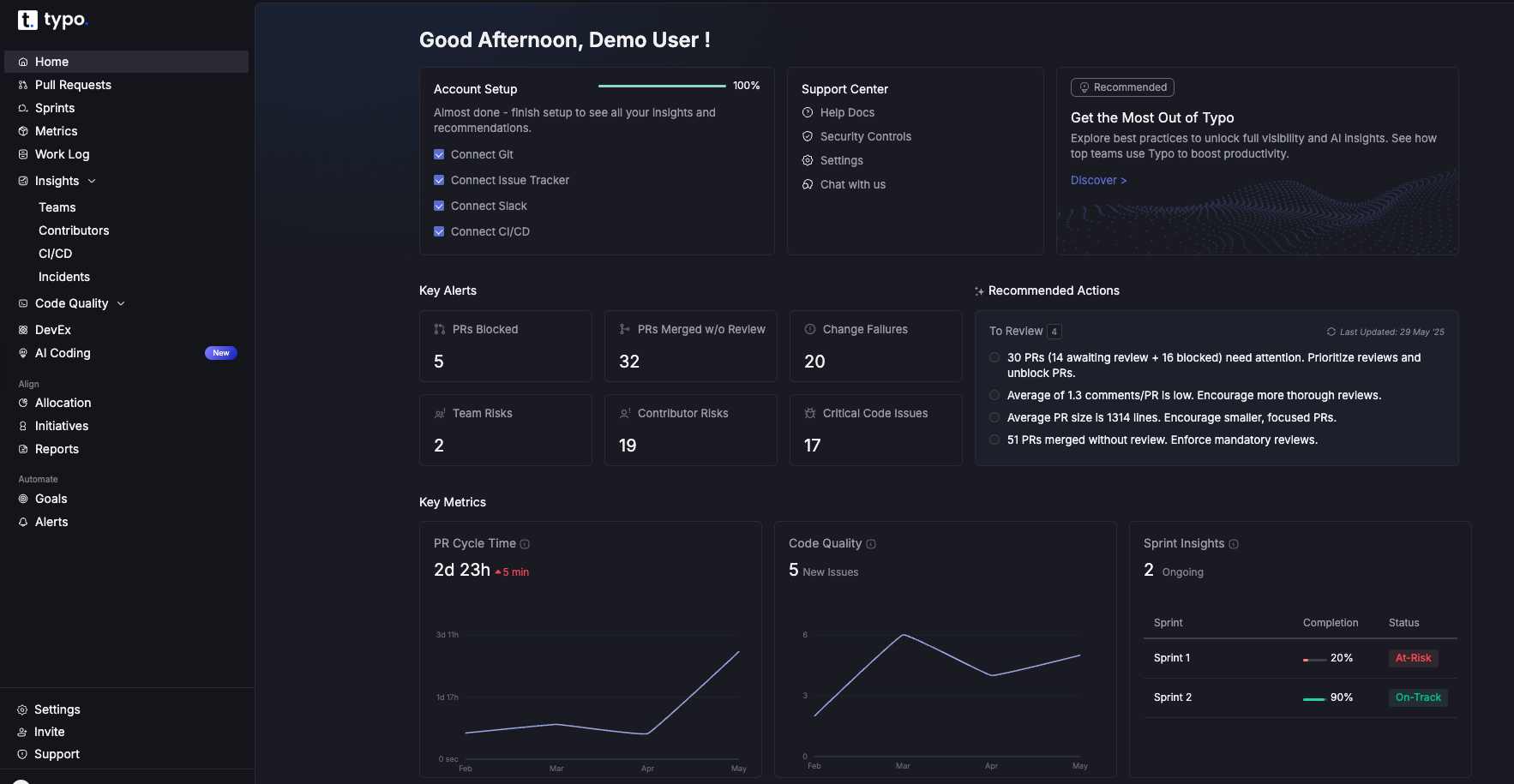
GitHub is a popular git repository hosting service for code sharing. It offers robust source code management and supports a wide range of version control tools, making it essential for collaborative software development. GitHub is the leading platform for version control and source code management. It is a cloud-based tool that allows you to configure, control and maintain code bases with your team. GitHub helps teams track code changes and manage collaborative development efficiently. It also offers features such as bug tracking, feature request, and task management. Github’s supported platforms include Windows, Linux, MacOS, Android, and IOS.
GitHub Key Features:
Bitbucket is the largest version repository hosting service owned by Atlassian. It provides unlimited private code repositories for Git. Besides this, it also offers issue tracking, continuous delivery, and wikis. Bitbucket features seamless git integration, enabling streamlined development workflows and efficient source code management. This allows teams to track code changes and connect with version control systems to enhance productivity. The supported platforms for Bitbucket include Linux, AWS, Microsoft, and Azure.
Bitbucket key Features:
Jira is an issue-tracking product that tracks defects and manages bugs and agile projects. Jira is widely used by agile teams to manage software development projects and development projects of all sizes. It has three main concepts: Project, issue, and workflow. Jira is primarily used for backlog management and creating flexible workflows. Available on Windows, Linux, Amazon Web Services, and Microsoft Azure, Jira can be integrated with various engineering tools. A few of them include Zephyr, GitHub, and Zendesk.
Jira Key Features:
Linear is an issue-tracking tool for high-performing teams. It is used for streamlining software projects, tasks, and bug tracking. The majority of repeated work is automated already which makes the SDLC activities faster. It has more than 2200 integrations available such as Slack, Gitlab, and Marker.io. Linear also offers real-time git integration, making it ideal for teams focused on streamlined development workflows. The supported platforms for linear are MacOS intel, MacOS silicon, and Windows.
Linear Key Features:

ClickUp is a leading issue-tracking and productivity tool. It is highly customizable that lets you streamline issue-tracking and bug-reporting processes. It has powerful integrations with applications such as Gitlab, Figma, and Google Drive. ClickUp also supports integration with multiple tools, allowing teams to streamline workflows and manage tasks efficiently. ClickUp is available on Windows and Android.
Slack is a popular communication tool for engineering leaders and developers. It provides real-time visibility into project discussions and growth. Slack can also be integrated with monitoring tools to deliver real-time alerts and performance metrics, helping teams track system uptime and respond quickly to issues. This tool is available for many platforms such as Web, Windows, MacOS, Android, IOS, and Linux. Slack has an extensive app directory that lets you integrate engineering software and custom apps.
Slack Key Features:

Microsoft Teams streamlines communication and collaboration in a single platform. It assists in keeping up to date with development, testing, and deployment activities. Available for Web, IOS, Android, Windows, and MacOS, MS Teams includes built-in apps and integrations. Microsoft Teams is also well-suited for large enterprise environments that require secure, scalable collaboration.
Microsoft Teams Key Features:
Discord facilitates real-time discussions and communication. It is available on various platforms which include Windows, MacOS, Linux, Android, and IOS. It has an advanced video and voice call feature to collaborate for SDLC activities.
Discord Key Features:
Jenkins is one of the popular CI/CD tools for developers. It is a Java-based tool that produces results in minutes and provides real-time testing and reporting. By automating repetitive and critical development tasks, Jenkins helps reduce human error, thereby improving efficiency and reliability. Jenkins is widely regarded as the gold standard for continuous integration and continuous delivery (CI/CD). Jenkins is available for MacOS, Windows, and Linux platforms. It also offers an extensive plug-ins library to integrate with other development tools. Github, Gitlab, and Pipeline to name a few.
Jenkins Key Features:
Azure DevOps by Microsoft is a comprehensive CI/CD platform. It ensures that the entire software development delivery is done in a single place. From automating, building, and testing code, Azure DevOps brings together developers, product managers, and other team members. This tool has cloud-hosted pipelines available for MacOS, Windows, and Linux. Besides this, it has an integration of over 1000 apps built by the Azure community.
Azure DevOps Key Features:
AWS Codepipeline is an ideal CI/CD tool for AWS users. It helps in automating your build, release, and pipeline CI/CD processes. AWS Codepipeline also offers fast and reliable application and infrastructure updates. It enables teams to increase deployment frequency, allowing for faster feedback loops and greater operational agility. With easy steps, you can set up Codepipeline in your AWS account in a few minutes. This tool can also be integrated with third-party servers. It includes GitHub or your custom plugin.
AWS Codepipeline Key Features:
SonarQube is a popular static code analysis tool. It is used for continuous code inspection of code security and quality. SonarQube helps teams build secure software by identifying vulnerabilities early in the development process. The quality gate in this tool blocks any code that doesn’t reach a certain quality. It stops the code from going into production. It integrates with various code repositories such as GitHub, Bitbucket, and GitLab. SonarQube’s supported platforms are MacOS, Windows, and Linux.
SonarQube Key Features:
Codefactor.io is a code analysis and review tool that helps you to get an overview of the code base. It also supports analysis across complex software systems to maintain operational efficiency. It also allows you to get a glance at a whole project, recent commits, and problematic files. The powerful integrations of CodeFactor.io are GitHub and Bitbucket.
CodeFactor.io Key Features:
Selenium is a powerful tool for web-testing automation. It is implemented by organizations of different industries to support an array of initiatives including DevOps, Agile model, and Continuous delivery. Selenium, Cypress, and Playwright are open-source frameworks for automating web browser and end-to-end testing. Selenium is one of the best test automation tools that can be automated across various Os. It includes Windows, Mac, and Linux as well as browsers such as Chrome, Firefox, IE, Microsoft Edge, Opera, and Safari.
Selenium also supports testing for mobile apps across various devices and platforms, enabling automation, debugging, and performance tracking for mobile applications.
Selenium Key Features:
LambdaTest is one of the well-known test automation tools that provides cross-platform compatibility. It can be used with simulated devices on the cloud or locally deployed emulators. This tool can be integrated with a variety of frameworks and software tools. It includes Selenium, Cypress, Playwright, Puppeteer, Taiko, Appium, Espresso and XCUITest.
LambdaTest Key Features:
Cypress is an open source automation tool for front-end developers that operates with a programming language – JavaScript framework. It is one of the popular test automation tools that focuses on end-to-end testing. It is built upon a new architecture, hence, it can directly operate within a browser in the same run-loop as your application.
Cypress Key Features:
It is one of the automated code review tools for static analysis. Supporting more than 40+ programming languages, Codacy also integrates with various popular tools and CI/CD workflows.
Codacy Key Features:
One of the code review tools that is built on a SaaS model. It helps in analyzing code from a security standpoint.
Veracode Key Features:
GitHub Co-pilot is an AI pair programmer that uses open AI codex for writing code quickly. It also assists developers in debugging code across multiple programming languages, making it a versatile tool for both writing and troubleshooting code. The programmer is trained in natural language and publicly available source code that makes it suitable for programming and human languages. The aim is to speed up the development process and increase developers’ productivity. It draws context from the code and suggests whole lines or complete functions. GitHub works the most efficiently with few programming languages. These include Typescript, Javascript, Ruby, Python, GO, C#, and C++. It can be integrated with popular editors. It includes Neovim, JetBrains IDEs, Visual Studio, and Visual Studio Code. However, you need to install visual studio code for using GitHub on this platform.
GitHub Co-pilot Key Features:

Determining the optimal SDLC tools represents a transformative step that reshapes how development teams approach software creation and delivery. The right tools don't merely streamline processes—they fundamentally enhance collaboration dynamics, elevate code quality standards, and significantly reduce manual overhead for development teams. When analyzing SDLC tools, it's essential to examine how effectively they integrate with your current workflows, version control ecosystems, and project management frameworks. Seek out solutions that embrace multiple operating systems and programming languages, while offering advanced capabilities such as agile project management, continuous integration (CI), and comprehensive static code analysis.
Contemporary software development demands tools that facilitate seamless continuous integration and continuous delivery (CI/CD) pipelines, automated testing frameworks, and sophisticated software composition analysis. These capabilities serve as catalysts for reducing technical debt, amplifying test coverage, and ensuring your software adheres to rigorous security and quality benchmarks. Collaboration platforms such as Slack and Microsoft Teams prove invaluable for maintaining alignment among development teams, stakeholders, and customers throughout the entire development lifecycle, creating a unified ecosystem that drives project success.
These tools can assist you well while you work on SDLC activities.
In this article, we have highlighted some of the well-known tools for your team. You can research more about them to know what fits best for your team.
Sign up now and you’ll be up and running on Typo in just minutes

We're on a mission to build engaged, productive tech teams. Try it out for free!


Follow us on:


We're on a mission to build engaged, productive tech teams. Try it out for free!
Follow us on:


